
‘Every day is a journey, and the journey itself is home’ Basho
A personal tale, common to many; away from home, on a distant shore, caught up the ebb and flow of the everyday, we lose ourselves. Divided by political headlines, our memories become eroded. Missing home, I lament.
If only momentarily, we dream of escape. Conjuring an otherworld, we ostensibly undertake a journey; physically and in parallel a deeper discovery into oneself, from sound to silence.
Idealized, imagined utopias. Islands exist in a semi dream-like state. A distant memory or creation of our imagination.
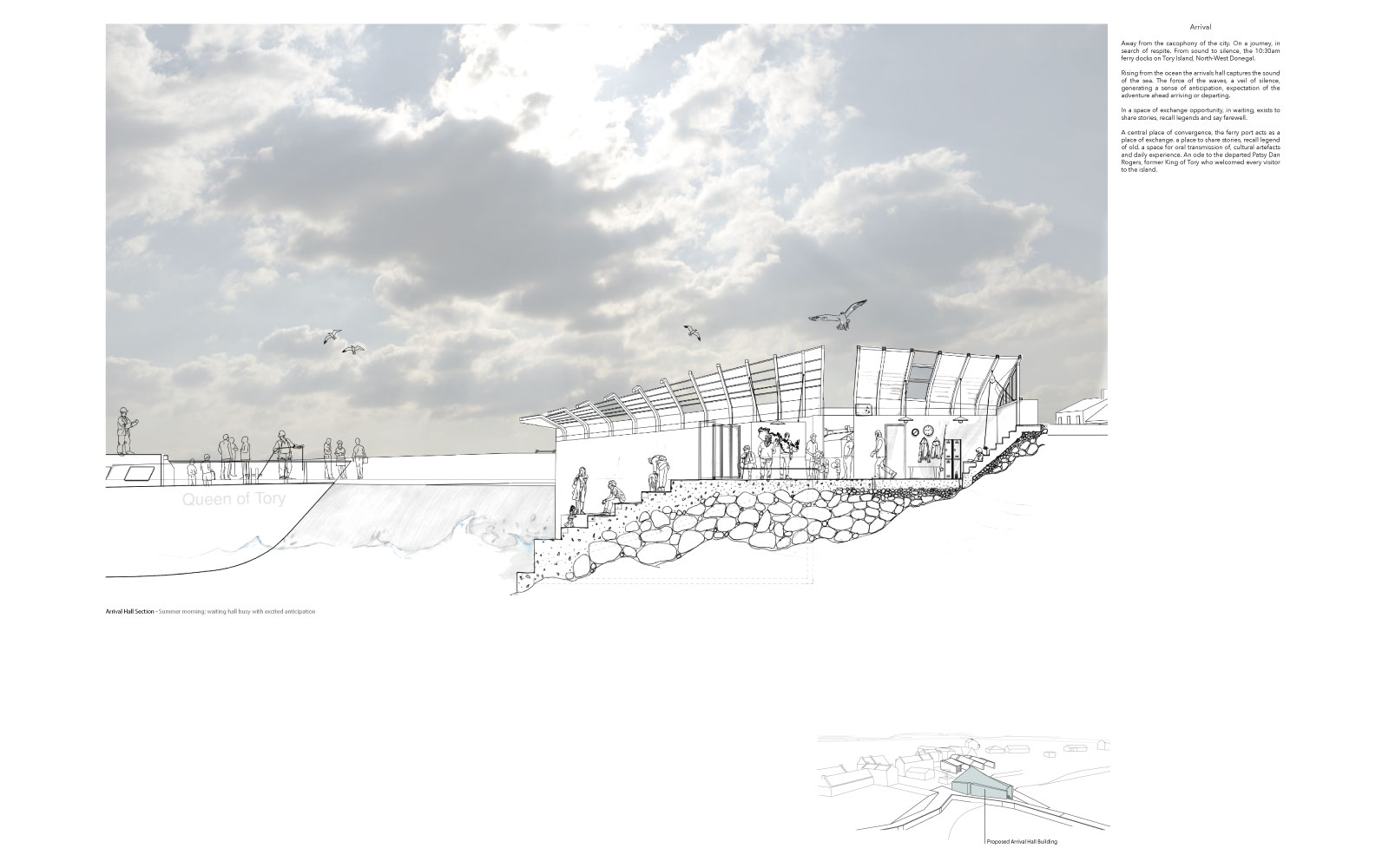
Tangible: Tory Island, shrouded in mythology sits isolated, silent. Resting on the shore the Arrivals Hall a shelter for islanders and visitors, a space for exchange, offers an opportunity to share stories. Connected sits hulled structures host fisheries and touristic functions support year-round sustainable economic activities.
The Music Hall; linked by a rhythmic pathway, a conduit between earth and sky; musicians as translators evoke the intangible mythological lore. Drawing from the granite geo-scape, legends of Tory converge with tales of distant lands. In the mode of Irish traditional music, the spaces promote a culture of oral transmission, of exchange. The tunes, vehicles for emotional expression making the invisible visible.
Departing, leaving this Atlantic edge, I return home, spirit reawakened ready to begin again.