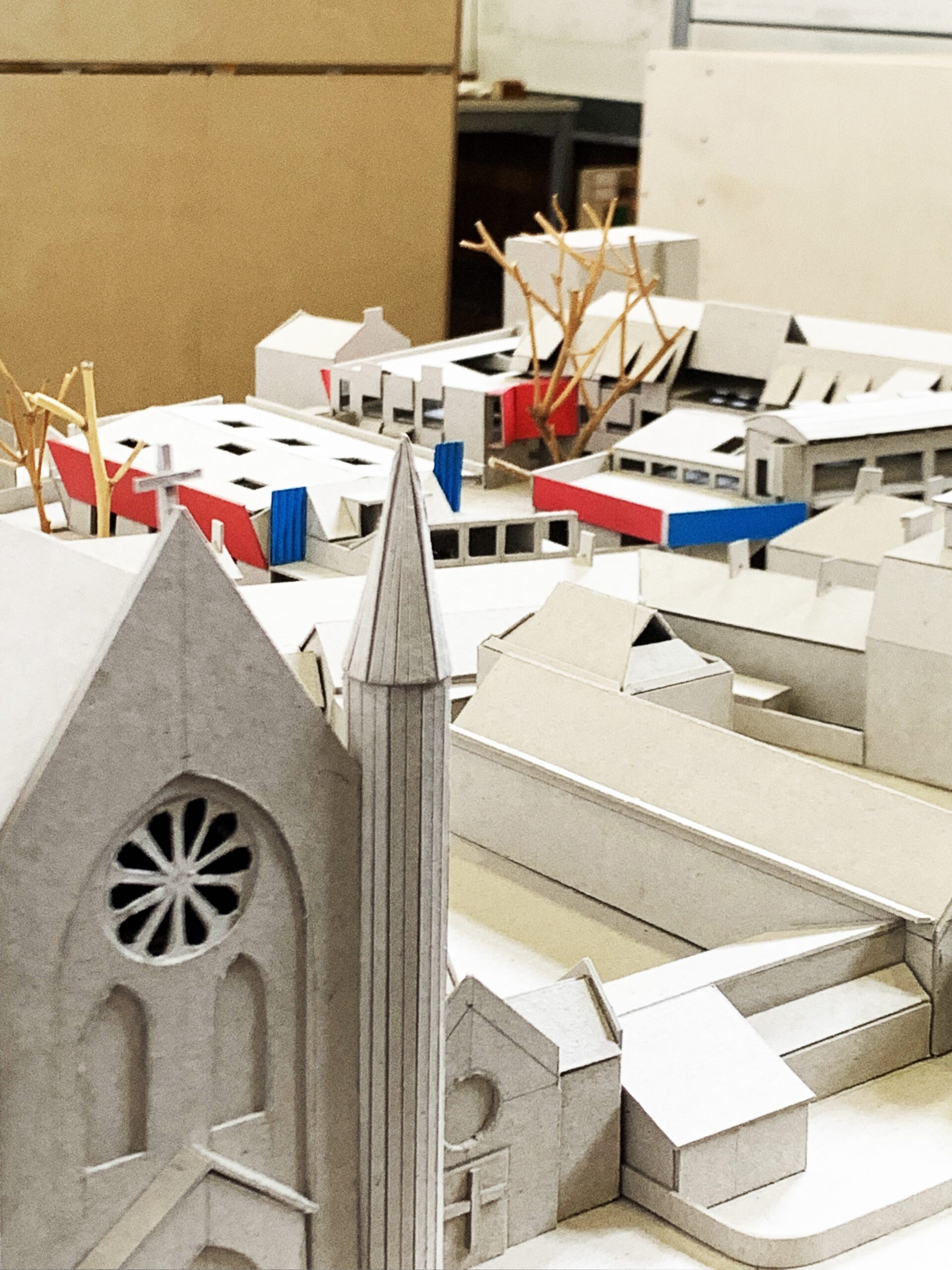
Reinhabiting the Backlands

This thesis explored the adaptive reuse of derelict sites in town centres to create functional homes, aiming to revitalise urban cores and attract residents back into these areas. The project began with an in-depth analysis of Narrow West Street in Drogheda, examining the potential retrofit of buildings in varying states of dilapidation.

Oscar Newman’s ‘Defensible Space Theory’ was a key influence throughout the design process, shaping a concept that prioritised community, safety, and privacy. These ideas informed the integration of semi-public spaces and defined thresholds, guiding residents from public streets into private dwellings while fostering a sense of ownership and security.

The design development involved testing two primary concepts. The first proposed demolishing rear extensions to accommodate a modern version of mixed-use developments. The second approach embraced the strategic reuse of the existing built fabric. This scheme aimed to preserve the site’s character while introducing communal indoor and outdoor areas that encourage interaction and shared responsibility among residents. The final design presents a vision for sustainable urban regeneration, one that respects historical context while creating a liveable, defensible, and connected neighbourhood.

‘Depth through layering’ Leeview Bakery & Community Centre, Sunday’s Well

This thesis looked at how depth is perceived through layering. It was explored through early analytical cubism which compresses space and time through reduction and layering. The compression of space through layering triggers a sense of flattened landscapes and led to the conceptual sketch of flatness of the site in Sunday’s Well.

The proposal is to maintain the character of the lanes of the site but to create a new edge adding social infrastructure as a plug -in to re-appropriate the existing backlands. This thesis is driven through the program of a Community Centre that houses a small bakery. It is explored through a layering of domestic size spaces. Circulation behind the horizontal planes restricts views before granting them on the vertical. Walls that never touch the ceiling creates a connection to multiple spaces simultaneously.

Learning from the material of the context, the building uses tiles to maximise and celebrate light within the vaults of the building. The building is another laneway providing open spaces for social engagements and rest points along the way. This new public route is sensitive to the existing lanes and remains open after the building closes. In its entirety the vaults are represented as flat and depth is compressed. The intention of this project is community engagement through these layers of re-appropriation.

Queer Coded

Queer Coded is a thesis project concerned with queer infrastructure in Dublin city and the architectural signifiers which reveal queer space. The primary design is situated on Bow Street in Smithfield between an abandoned dormitory building for the old Jameson distillery workers and an industrial block formerly the Crean Soap Factory. The work explores different approaches in designing queer space based on queer theory, various levels of coding, and a brief derived from the needs of existing LGBT+ organisations in the city (Outhouse and TENI). A written dissertation titled ‘Queer Domesticities’ was also created early in the process. Beginning with in depth theoretical and historical research allowed the design of this project to develop more naturally from an established understanding of queer space. The main spaces focused on are for a queer crisis and community center including emergency care and treatment, short term and long term housing, spaces of public engagement and protest, and event/club spaces to raise money for a grassroots approach to queer urban development. Rather than creating new monuments in the city to signify queer space, the existing network of churches are coded as the primary long ranged signifiers of new queer spaces. One of these new queer spaces is designed here to be a space both obscure and as a space of visible protest drawing from queer squatting + protest architectures. The proposal avoids flattening the site to build new queer space but instead allows a ‘queering’ of the existing buildings to take place. There is a push back against binary construction and conservation techniques, instead embedding new queer production within the complexity of the city.