A Landscape Infrastructure for Cork Harbour

The contemporary picturesque, as presented in this thesis, is a of landscape that is both cultural and industrial nature. Industrial, in that the landscape is a working, productive entity; adapting to changing uses over time, while paced to the tempo of natural and ecological processes. Cultural, in the sense of an empathetic engagement with it’s human collective.

A Landscape Infrastructure for Cork Harbour.
The sea’s potential to transform our contemporary world inspired our research group, to develop an idea for a ‘landscape infrastructure’ in Cork Harbour.

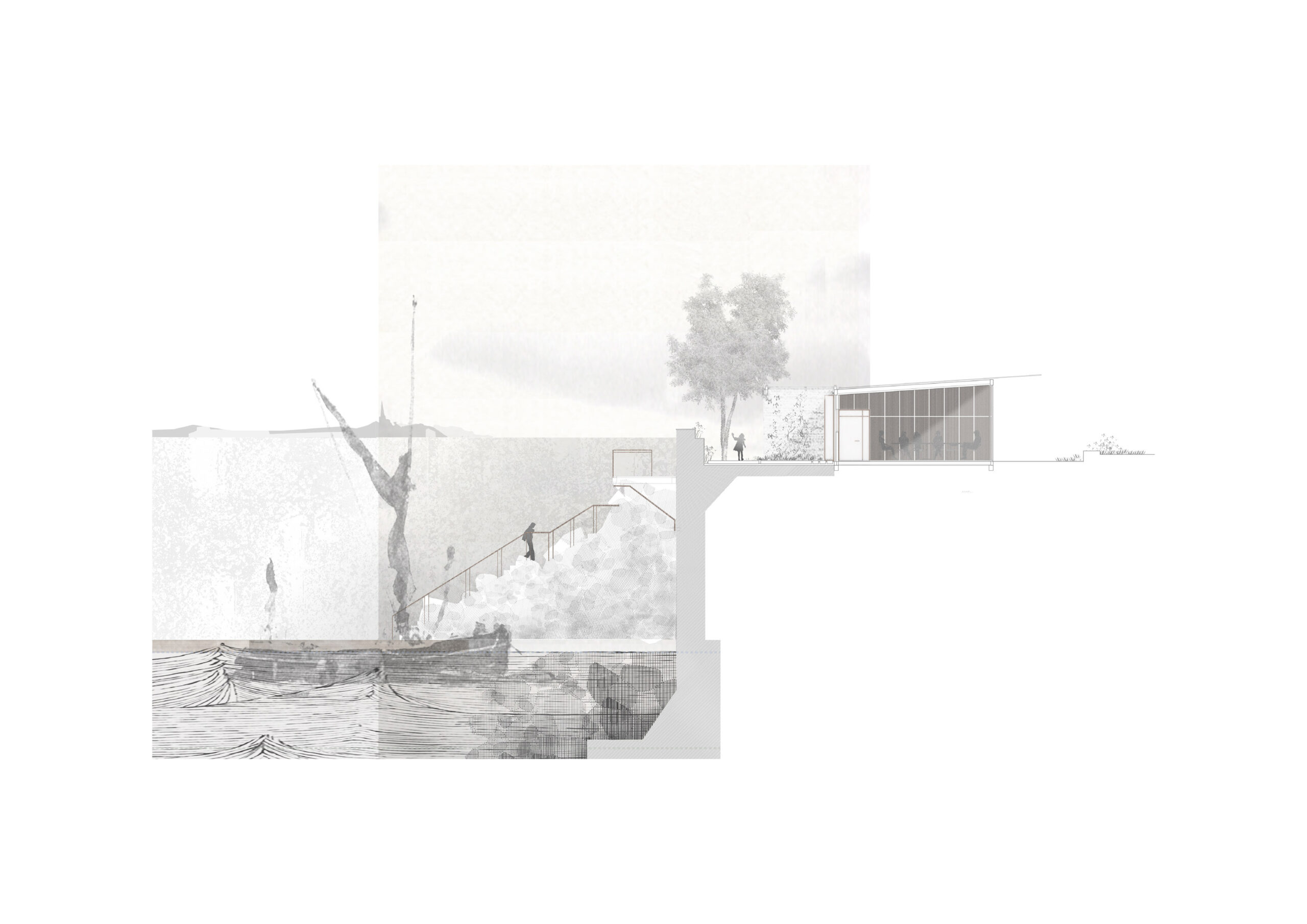
A research archipelago was designed to support the aspirations of the Irish Maritime Energy Resource Cluster IMERC’s, the needs of the Irish Navy and National Maritime College and the environment of Cork Harbour. With the absence of an immediate community of inhabitants, it therefore, tests the ideas of an imagined place developing over time. A landscape of islands is reclaimed, the industrial slagheap is remediated and a tidal wall for wave energy production is created. A network of waterways, walls, wetlands and transport routes, supports the setting for maritime research, testing and training. The tapestry is enriched with a programme of accommodation, public spaces, trading buildings and reprogrammed industrial warehouses.

To evoke the atmosphere of this uniquely imagined seascape, a set of individual research projects were set on this invisible territory.

This study repossesses unprogrammed ground to connect the archipelago in a landscape of public space. Taking cues from topography and history, it carves connections between the existing naval base, remnants of industry, new island additions and natural landscape for new and existing communities to share. The social agenda of the proposal, is a burial ground and public garden for permanent and visiting communities of the islands. It attempts to balance the local identity of Cork Harbour, global influences and the needs of the natural environment. The design moderates private and public thresholds to create spaces for people to meet, share and enjoy in a number of ways. At the same time, it is a geographically sensitive seascape and natural habitat and a place to reflect on time and ecology.
CIANOBAIR: The Architecture of Remote Work in Donegal

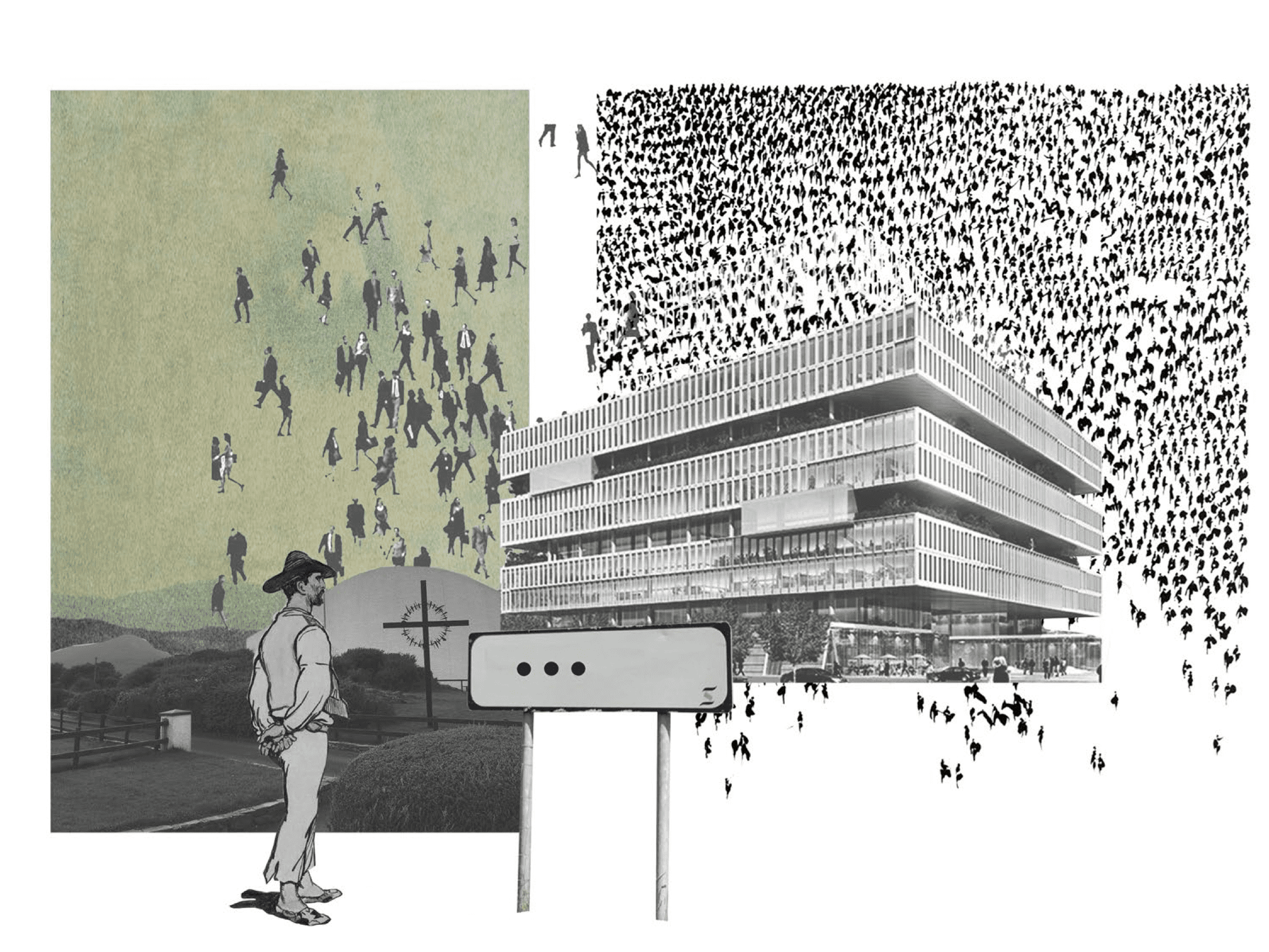
The thesis explores the emerging role of remote working infrastructure in the revitalization of Irish towns.

Often interpreted as an isolating activity, the thesis proposes the reinterpretation of remote work as a collective endeavour: one with the capacity to challenge, reconfigure, and ultimately reform notions of how we live today. Situated at a critical juncture with regards to how we might move forward, the thesis asserts the question:
What is the architecture of remote work going to be?

In response to recent government policy acknowledging the ‘remote working hub’ as infrastructure, the thesis consciously interrogates and reframes the role of these infrastructures to shed light on how they could adopt a broader role in addressing the emerging needs of Irish Towns.

This is explored through a situated case study in the town of Ramelton, Co. Donegal that reconceptualizes the infrastructure as a responsive civic amenity: one where social, cultural and community programs have been integrated alongside co-working spaces in a critique of the infrastructure’s homogenous commercial role. This amenity is spatialized through the adaptive re-use of former warehouses at The Quay in Ramelton. The infrastructure has been translated through an approach that enables flexible appropriation of the existing fabric and emphasizes the social role of work in the life of Irish towns.

The thesis aims to construct a dialogue with regards to the role of public infrastructure; aligning broader social and environmental ambitions with specific architectural considerations through policy, and the evolving role of what it means to live and work in Irish towns. This dialogue advocates for a responsive approach to the implementation of these infrastructures where they deeply engage with the affordances of their status as public infrastructure.

Living with Machines

Approximately one third of the Irish population live in towns, another third in surrounding rural areas. Yet these rural settlements are in a state of crisis fueled by vacancy and inefficacious public spaces; their identities are in urgent need of repair.

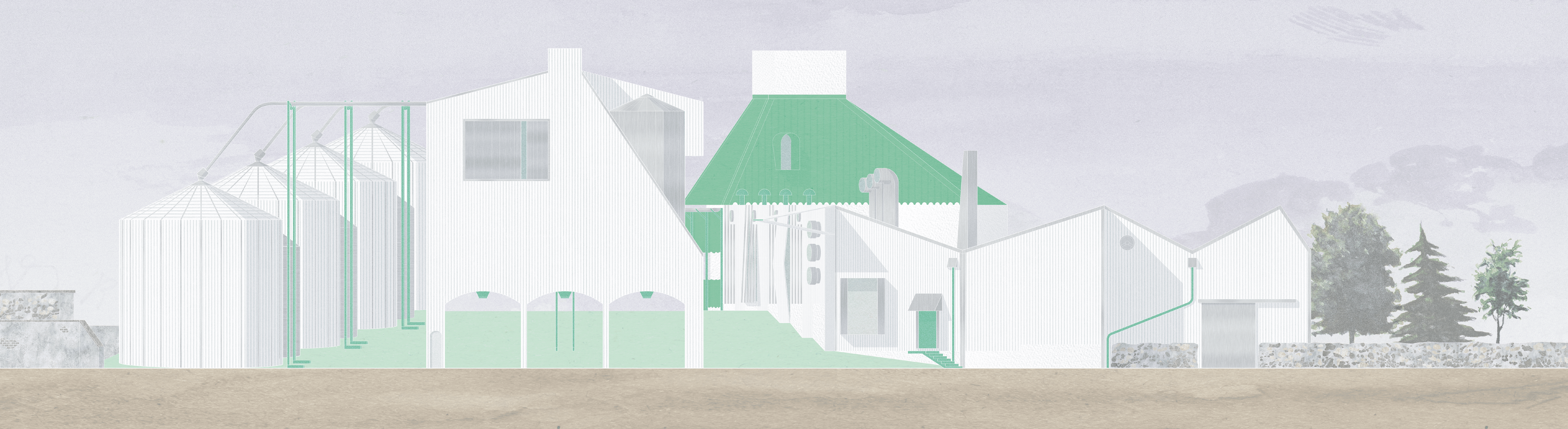
Situated in the small town of Tullow, Ireland, this thesis is grounded in the deep-rooted interdependence between this community and its agriculture, addressing the issues of public space, identity and festivity in the contemporary Irish town. Rejecting a romanticisation of the bygone days, and instead focusing on making explicit the inherent identities and existing cultural fabric of local communities. The architecture becomes an honest portrait, driven by a celebration of the everyday.

The project celebrates the ambivalence of contemporary rural living in its many dualities, combining the town’s seasonal grain drying industry with a town hall and public space. Reimagining the role of the town square in contemporary communities, the existing market square and the new Grain Square are conceived as a pair of unidentical twins. They serve distinct and complementary roles for the town, threading together a sequence of pedestrianized rooms connecting the town’s heart to its hinterland. The Grain Square acts as the interface between the everyday routines of townlife and the workaday rituals of modern farming. Unfolding against the backdrop of the evolving tones, forms and textures of a local agrarian calendar, they serve to mend the fractured identity of this contemporary town.

The Foyer, An Investigation of Social and Economic Barriers to Health

The focus of my project is to explore a way to reduce health inequalities that exist in our society today. This includes people who are socially excluded within the city. It attempts to create a healthier city by integrating communities, placing value upon our public realm and forming an attitude towards the need for civic interaction while creating the best kind of internal and external environment – one that honours the needs and well-being of those who will use it.

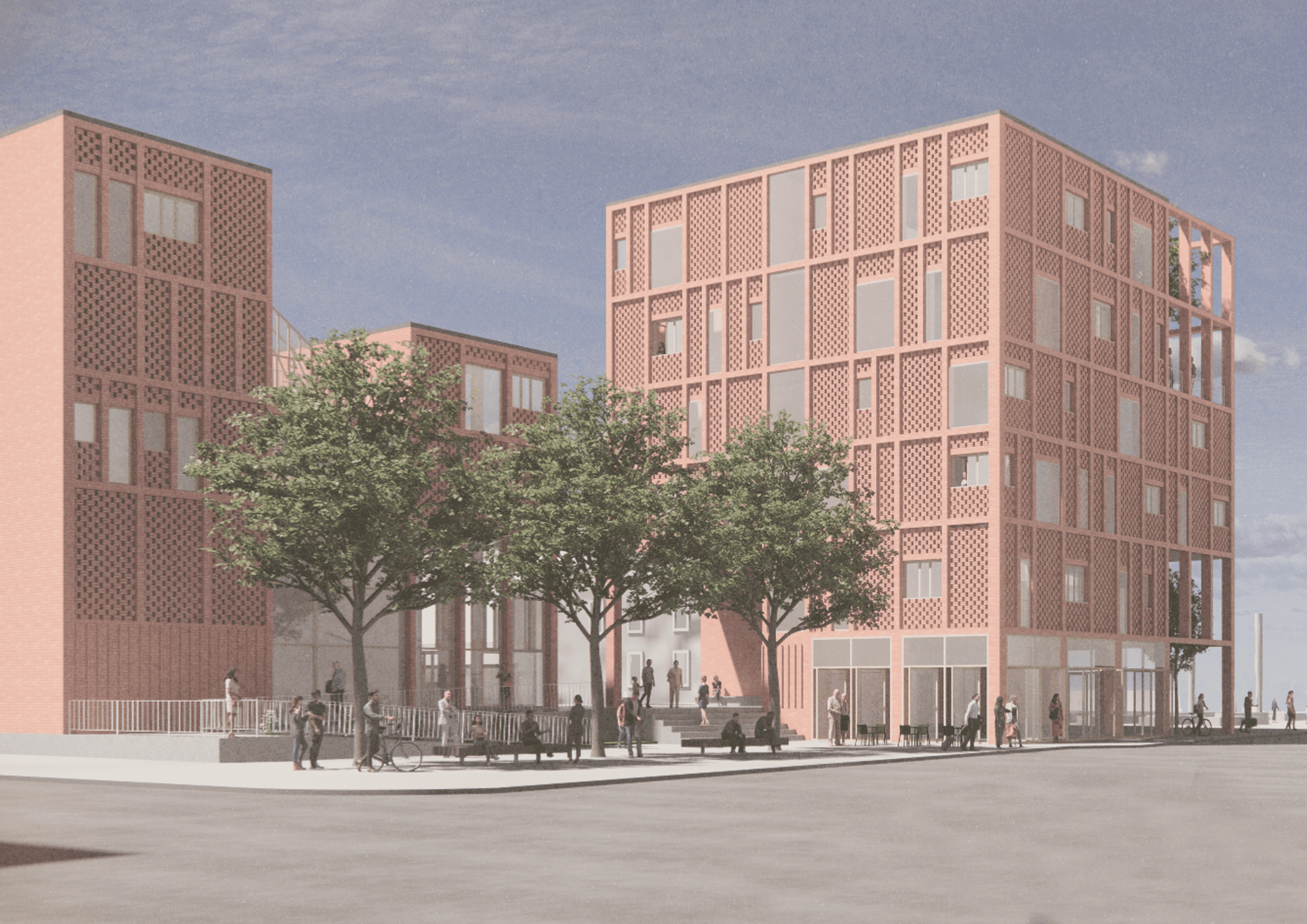
The proposal sets out to create a Foyer for the city which reflects a new public house. It will include multi-use facilities including a reception foyer, a community café, G.P suites, counselling rooms, a branch public library, community rooms and an accommodation block. It addresses a shortcoming in civic institutions and civic places that allows for the welcoming of these people who may need short-term to medium-term support.

The chosen site for this exploration is a vacant plot adjacent to Colbert Station in Limerick City, Ireland. It is situated along Parnell Street, a site where I have observed a very evident explicit result of impoverishment. I have recognised that there is an abundance of people within this part of the city in dire circumstances that we have become so anaesthetized to. Thus, I have located the building in an area of the city where it is most needed.

The constriction of the proposal is made up of a red brick double-stacked open stretcher bond, it is a self-supporting façade intermittently tied back to a glulam column and beam superstructure to allow differential movement. Its colour echoes that of the surrounding Georgian buildings to add some unity to the streetscape. The double stacked and open bond of brickwork states the envelope is not load bearing but a screen enveloping the whole building creating different types of environments of light and ventilation conditions through various treatments of the perforated brick.

The Castle Centre: Shining a Spotlight on Architectural Form

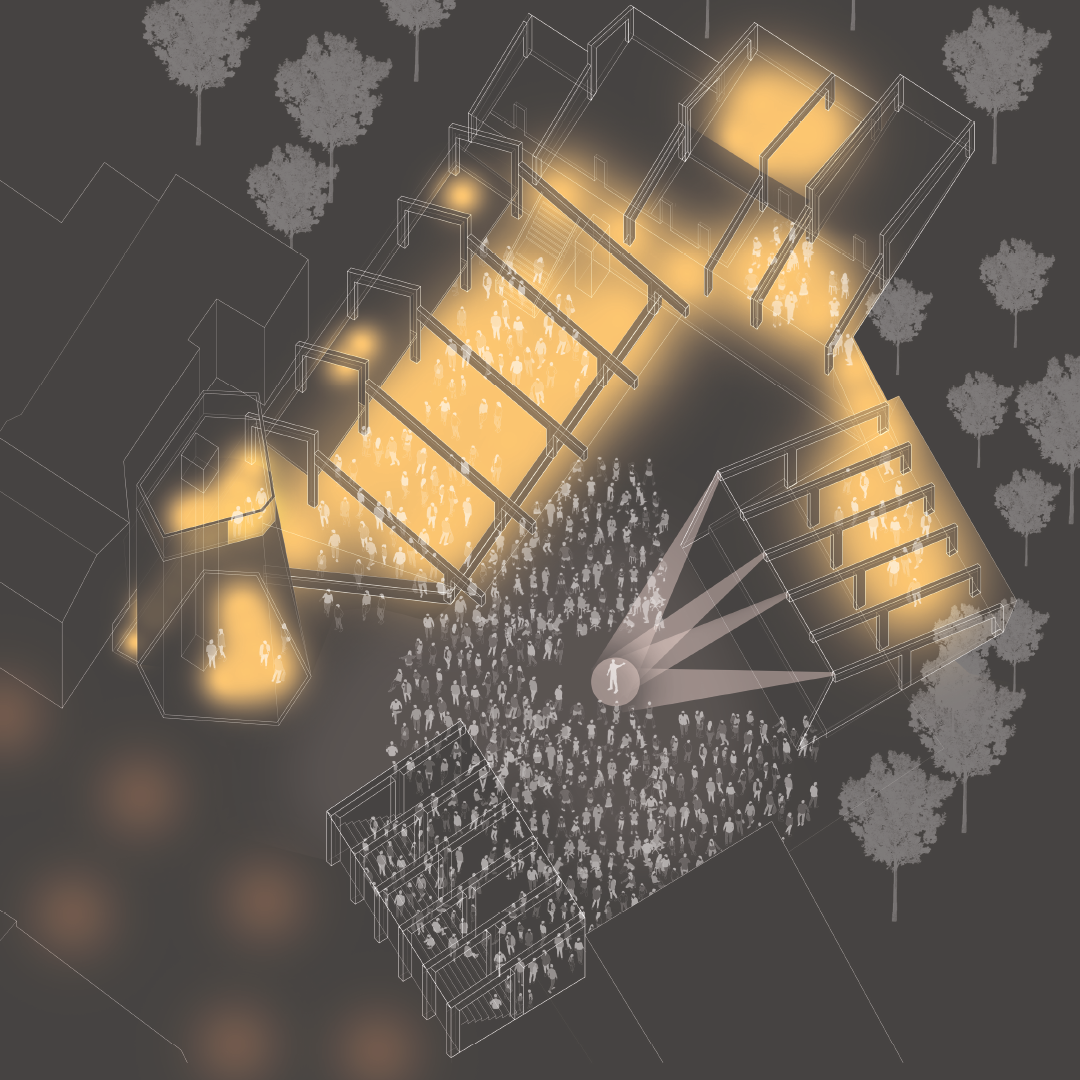
The Castle Centre, situated on an inflexion between the seafront and the commercial heart of Ballycastle, provided an opportunity for an exciting performance and social hub, something wholly unique for the North Coast of Ireland. The design takes shape around five key concepts: a break in the street, a beacon for ‘the island’, the potential for two facades, using the agricultural barn as a structural module and ‘place making’. It is the very crux of the project that it must not only serve the local community and heritage, but also be a mirror of it. The elements include a central hall, individual study spaces, flexible meeting facilities, a outdoor seating facility and a purpose-built stage facing the square, with the tower being a physical representation of an attitude taken to the community which the building intends to serve: can this hub not only facilitate Ballycastle, but also the population of Rathlin Island, who are so dependent on the mainland. Through a physical beacon, which calls to the lighthouse typology so ingrained within the coastal environment, the net which the project’s cast is widened.

The long-standing ritual of barn raising became a key player in the narrative of the project. It provided the basis from which the structural module was created, and thus the project takes its form from the module. The material pallet is selected as to create independent experiences on the exterior and interior: The exterior is detailed through concrete at a human scale which is separated from the constant pitched roof by glazing. The interior is distinguished through a timber ply finish and glulam structure, creating an instant separation between inside and outside. This structural identity is dictated so that certain spatial moves can result in special places being experienced. This manifests itself predominantly in the meeting points between elements; roof and glazing, floor and wall, wall and ceiling.