
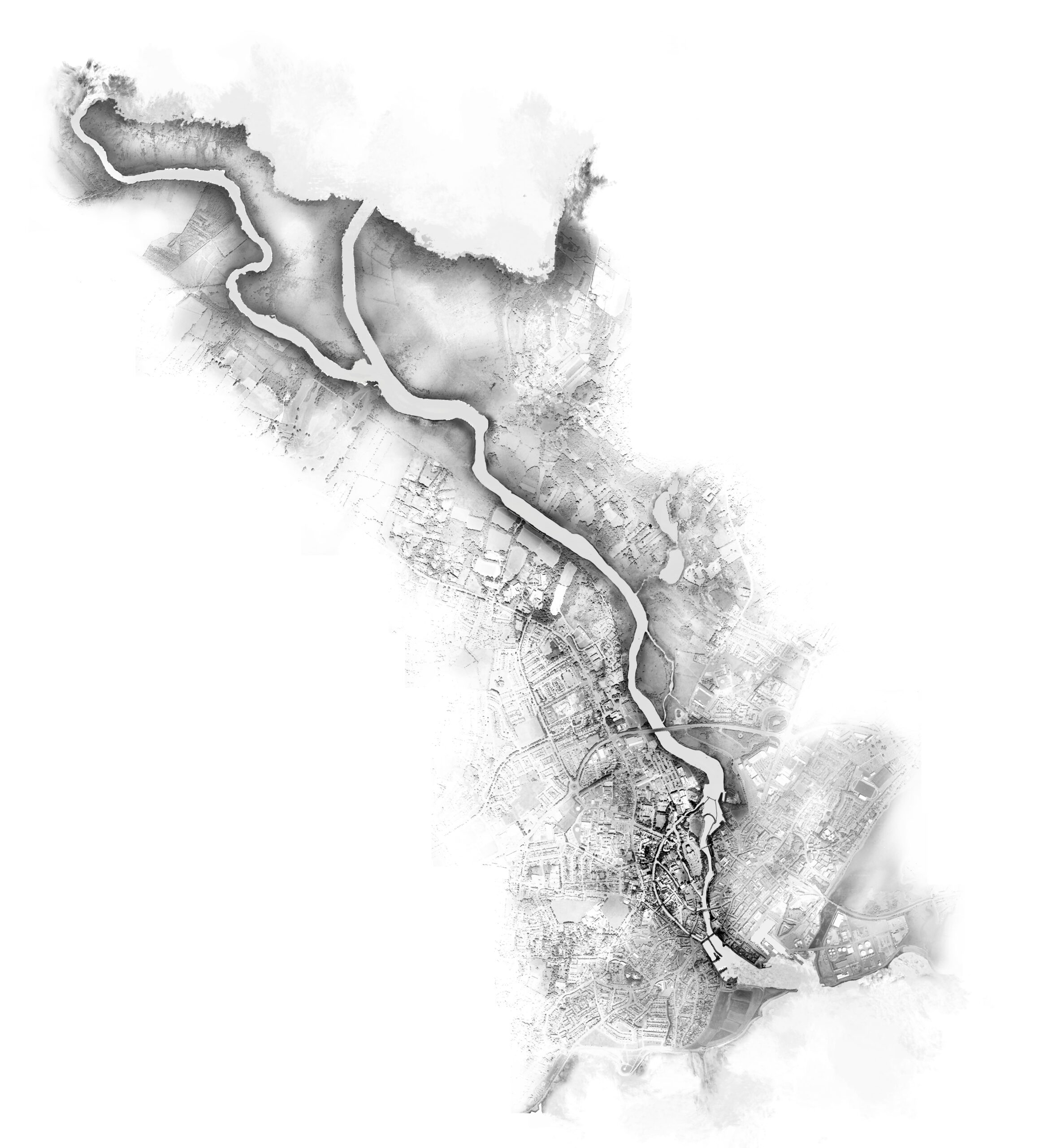
Testing to Failure ; A Trade School for Stonemasonry

Set within a rewilded limestone quarry on the edge of Drogheda, ‘Testing to Failure’ proposes a trade school for stonemasonry rooted in gravity, craft, and structural honesty. The project asks a simple but urgent question: what can architecture learn by returning to physical experimentation?

Historically, Gothic master builders and later figures such as Frei Otto used physical models to discover structure through force rather than drawing alone. This thesis revives that tradition. Hanging chain models, clay maquettes, and compression vault prototypes were built and intentionally pushed to collapse. Failure became a design tool. Each break revealed how form, force, and material negotiate equilibrium.

The quarry site is both origin and teacher. It is where stone was once extracted to build the town; now it becomes a place to rebuild knowledge. Rather than imposing geometry onto the terrain, the architecture follows the slope, embedding itself lightly within the landscape. Early water-flow experiments over a site model allowed gravity to guide orientation and circulation, reinforcing the thesis ambition to work with, not against, natural forces.

The school is constructed in local limestone using compression-only arches and vaults derived from inverted chain geometries. Spans were refined through iterative testing to ensure structural feasibility without hidden steel reinforcement. Even the foundations evolved: concrete retaining walls were replaced with dry stone construction and recycled quarry infill, strengthening the project’s commitment to material integrity and circular logic.

Programme is layered along the slope: public exhibition and café spaces at entry level, workshops and stone yards embedded below, and classrooms positioned to overlook active construction. Students learn by building the very architecture they inhabit. The building becomes a didactic instrument. Its structure visible, legible, and expressive.

Testing to Failure proposes a future where low-tech craft and digital validation coexist, where compression is rediscovered as a sustainable structural language, and where Stone is the driver of cultural regeneration. In the collapse of a model, new architecture begins

Symbiotic Relationship of Humans & Rivers

The project explores the relationship between humankind and rivers: how humans perceive rivers and the two-way interactions that occur. It views rivers from a selection of perspectives such as the river as a life source, a transport route and a power source.

The site is the River Corrib and the surrounding land of Galway city. The design project will focus on Madeira Island, now a surface car park. The River Corrib once powered Galway city’s industry and trade but now has a much less prominent role in the city. The fact that the city is built on a massing of islands, shaped by a network of waterways, is no longer evident due to the orientation of public buildings and main routeways.

Education has long been an integral part of Galway city life. The city centre currently hosts a university, three secondary and primary schools. However, all three secondary schools are in the process of migrating outwards in search of larger grounds in the suburbs.

The aim of the project is to provoke public re-evaluation of the river and to re-orientate people towards it. The programme is a music school to strengthen the weakening educational framework of Galway’s city centre