
Meitheal Distillery: A Holistic Approach to Integrating Town, Community and Industry

Meitheal Distillery reimagines the role of industry in the town as a centre of community life rather than a privatised operation. Drawing on the Irish tradition of Meitheal, when communities would work collectively, this project explores how whiskey production can be meaningfully integrated into the social, spatial, and economic fabric of a rural town.

The project stemmed from my own interest in the role of the pub in the community and I drew from my own experiences running a family owned pub. I wanted to explore how this unusual setting was the heart of many villages and towns throughout Ireland and how the same sense of community and engagement could be transferred to an industrial site.

Various opportunities for the distillery to engage with the surrounding town and community was explored. The creation of internal squares encourages spontaneous interactions between workers and locals. By embedding the distillery within the urban grain, this encourages the community to engage with the site. By retaining the natural features on the site, the locals can learn about the role of foraging in whiskey flavouring and continue to use the natural landscape in the greater town to contribute to a more authentic product. Using paving to outline the private and public areas furthermore allows visitors and workers to explore the distillery safely and within their means. Reintroducing dying skills such as coopering would promote local employment, revive craftsmanship and encourage the uptake in apprenticeships within the industry. The use of charred timber allows for both the distillery to be self-sufficient in repairing and advertising the craftsmanship of the coopers creating a greater sense of pride in place. Meitheal is not just a distillery but a regenerative model for industry that is porous, productive and proudly local.

Amelioration, Information and Architecture

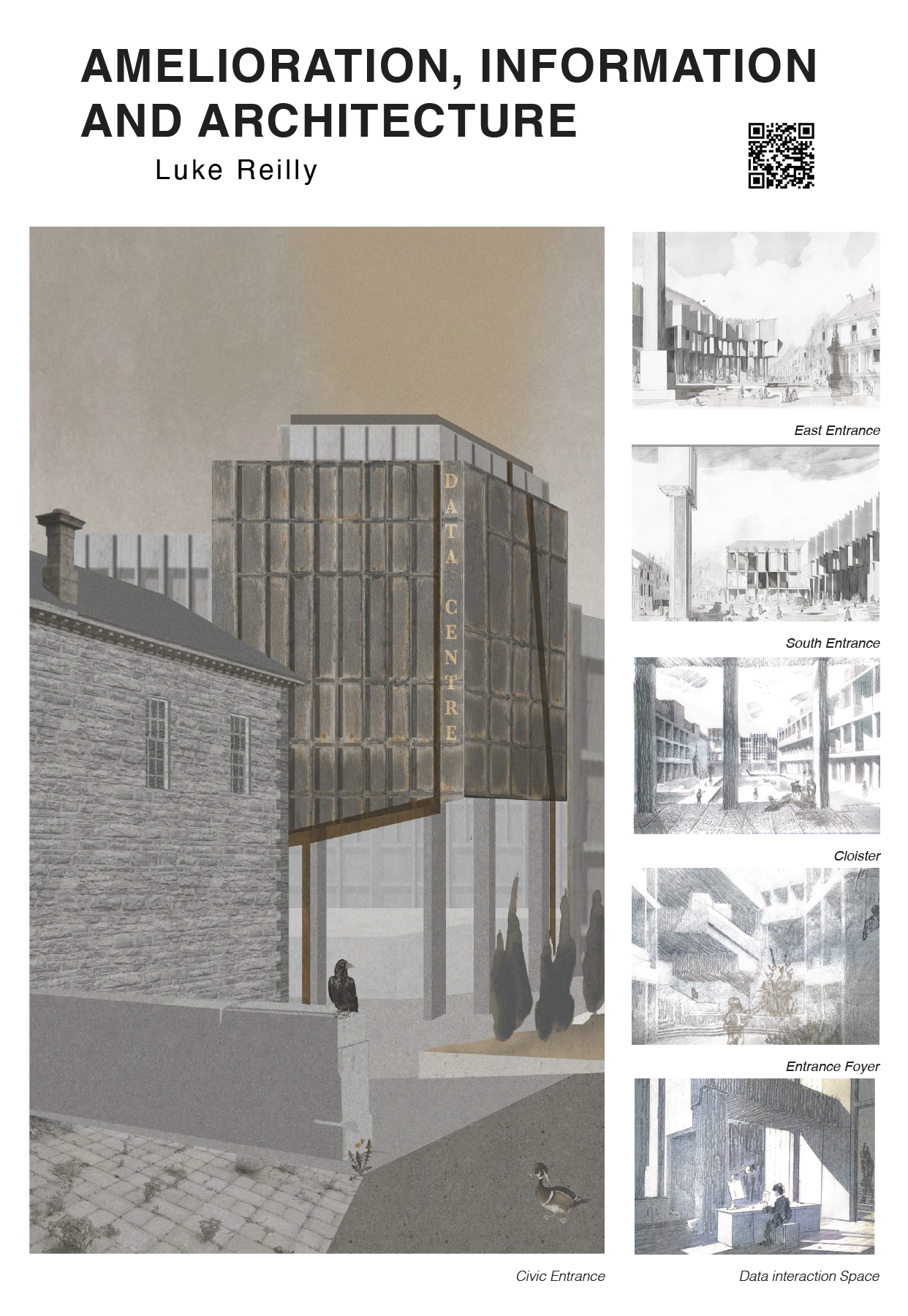
This thesis investigates how consequential buildings such as data centres are an aftereffect of our overuse of energy and dependence on information storage. 

I would like to question our intense interactions with the land, our production of data, our remaining balance of energy and our obsession with growth. We live among anti-human structures that are an invisible extension of our modern lifestyle; an integral infrastructure of the present-day future. Steel-clad objects are a by-product of our interdependence on information, data and the cloud. 

Our dependence on data centres has created an over-reliance on energy and water for the upkeep of these organisms’ vitals. As autonomous structures; their use of resources as commodities are verging on becoming a privilege. The buildings are that of storage, a space without windows, a place without feeling, a room without inhabitants. Four walls partition all information about us; yet this space is not for you or me. Can our understanding of data centres be rearranged and dismantled as easily as they could be taken apart? 

The data centre can be a place for the people; as an educational space that ensures understanding of our future. We can urge for degrowth and retain our architectural esteem through delicate interaction with the land and form buildings for people, with care and consideration for the present. An energy monastery.

The locus of this thesis is the basin of the River Shannon, but not confined to its floodplains. The river holds more influence than just what it touches currently. Using this body of water almost as a metaphor for the development of the systems which are now essential to us. The river Shannon is ever-present but human interaction is forever re-arranging around her, from ecclesiastic settlements to Bord na Móna power stations.

Sometimes it is a slight reconfiguration which leads to the biggest impacts on the system to which we plug-in to.
Inland Waterways Centre

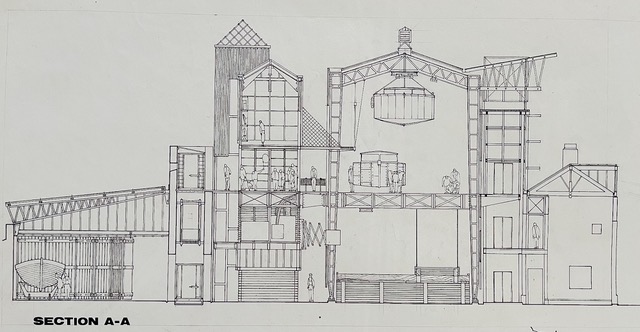
Inland Waterways Centre, Burgess Park, Golden Island, Athlone town centre, including Exhibition Hall, boat making spaces, viewing gallery at key curving site on the Shannon, Ireland’s longest river.