
Galway Crematorium and Burial Grounds

The project, a crematorium and garden for the burial and scattering of ashes, is situated in Menlo village. The site lies between an existing cemetery and a small woodland, with the River Corrib running along its boundary. The intention of the project was to create a strong link between the traditional burial ground and a new garden of remembrance, embedding the new crematorium into the landscape. Visits to recently established crematoriums revealed a lack of depth in these spaces, which often feel commercial and do not fully serve their purpose. The programme is structured around two distinct orders: the symbolic, centred on the chapel; and the industrial, serving the cremators. In interpreting the brief, the design evolved as a series of parallel constructions: Existing cemetery – Proposed crematorium and grounds Crematorium building – Burial landscape Chapel – Cremator Entrance with coffin – exit without The building is aligned with a natural path that runs from the cemetery to the woodland on the opposite side of the site, while maintaining a safe distance from the river to address potential flooding. The final design comprises three independent thatched roofs covering an arrival space, chapel, and condolence room. A grass roof covers the sunken staff areas and the cremator. The car park is positioned behind an existing ditch, screening vehicles from the burial grounds. As mourners approach the crematorium, they follow a path along an external wall beneath a canopy that reaches out to invite visitors into the arrival space. Inside the chapel, seating is arranged in an informal circle around the catafalque, the focal point of the space, with mourners seated in light surrounding the coffin. A concrete gable wall, read independently from the timber roof structure, frames views through carefully placed openings, including a view to Menlo Castle, and acts as a transition between chapel and the cremator. The coffin passes mechanically through an aperture in the concrete wall. In the surrounding garden, limestone burial walls radiate into the meadow, decreasing in scale. Formed from precast concrete niches set within dry limestone walls, they reference local stone field boundaries.

Living with Machines

Approximately one third of the Irish population live in towns, another third in surrounding rural areas. Yet these rural settlements are in a state of crisis fueled by vacancy and inefficacious public spaces; their identities are in urgent need of repair.

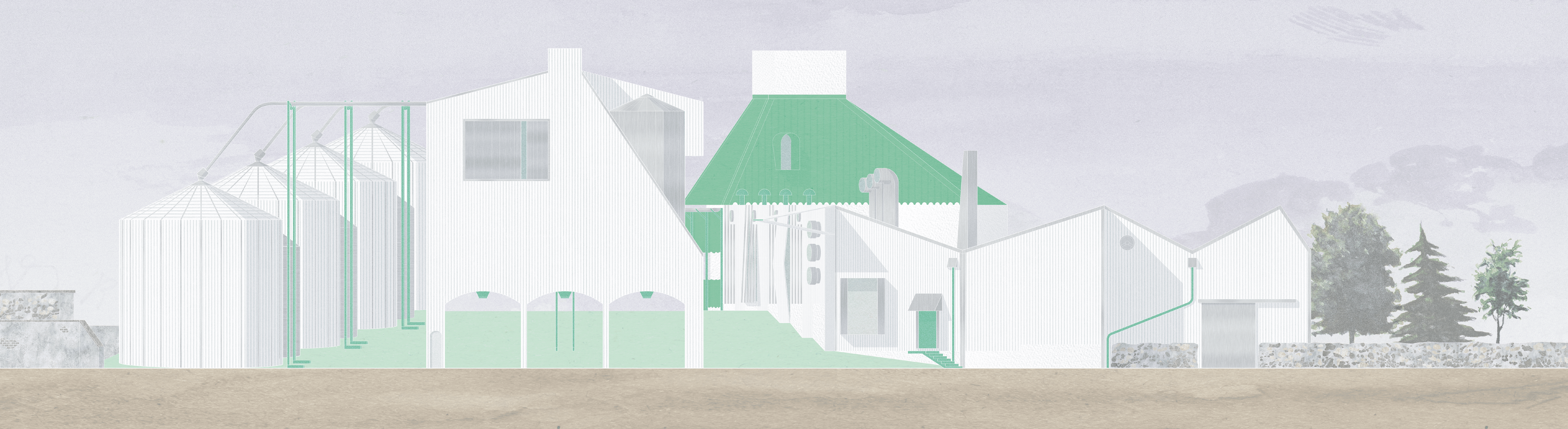
Situated in the small town of Tullow, Ireland, this thesis is grounded in the deep-rooted interdependence between this community and its agriculture, addressing the issues of public space, identity and festivity in the contemporary Irish town. Rejecting a romanticisation of the bygone days, and instead focusing on making explicit the inherent identities and existing cultural fabric of local communities. The architecture becomes an honest portrait, driven by a celebration of the everyday.

The project celebrates the ambivalence of contemporary rural living in its many dualities, combining the town’s seasonal grain drying industry with a town hall and public space. Reimagining the role of the town square in contemporary communities, the existing market square and the new Grain Square are conceived as a pair of unidentical twins. They serve distinct and complementary roles for the town, threading together a sequence of pedestrianized rooms connecting the town’s heart to its hinterland. The Grain Square acts as the interface between the everyday routines of townlife and the workaday rituals of modern farming. Unfolding against the backdrop of the evolving tones, forms and textures of a local agrarian calendar, they serve to mend the fractured identity of this contemporary town.