
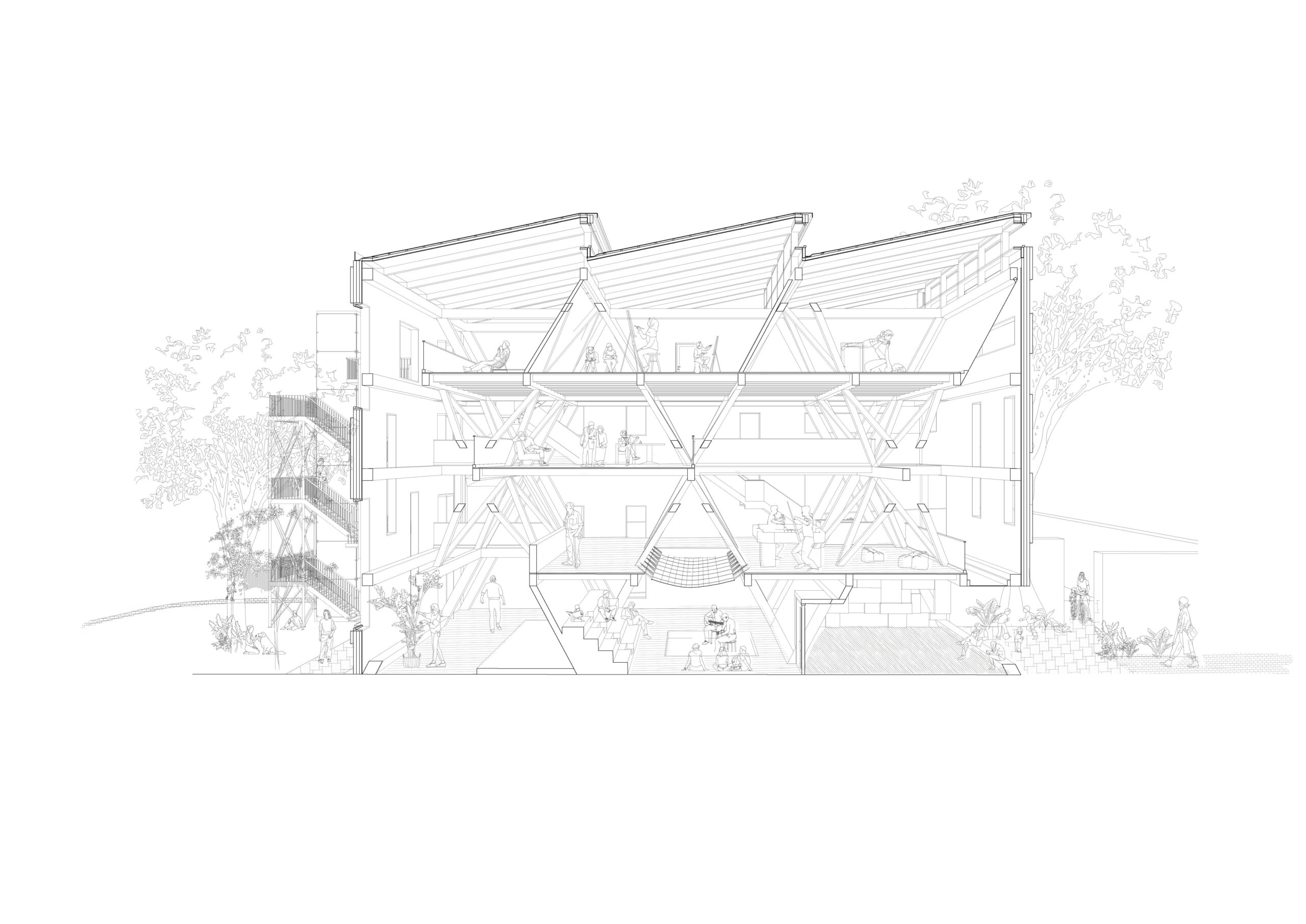
My thesis interest lies in the design and thought behind public spaces in Irish towns and how it impacts the identity and well-being of individuals in a community. Through a study of urban spaces that engage with the success and failures of specific conditions used, I attempt to understand how we as architects can provide a true, successful public realm for communities.
My chosen locus is the small town of Baltinglass in County Wicklow. With a population of 2,760, it’s located west of the Wicklow mountains. Baltinglass is a commuter town to Dublin and has a valuable history with multiple protected buildings. From once a rich community orientated town to now a vehicle and money ran town, Baltinglass lacks the inclusion of a public realm and gathering point outside the fixed confines of the pub and sport culture.
My chosen site is located on the corner of Chapel Hill and Weavers Square, situated adjacent to a community hall and handball alley. My design of a community hub intends to listen to the people’s urgent needs and act as a ‘safe space’ away from work and home. I will propose a new design of Weaver’s Square to re-introduce a sense of community and a purpose-built area for the residents of Baltinglass.
The programme is a pedestrianised town centre with a community centre and private garden. The project aims to acknowledge the lack of pedestrian and community space within the town and develop the town centre into a focal point for activity and living.
Through a design of a playful timber structure and the use of cork oak materiality, the centre will inspire creativity and positive engagement featuring flexible studio/ performing spaces, quiet rooms, a range of exterior and interior seating and gathering points, 24-hour accessible areas and surrounding cork -oak forested walkways. Access to the building will be free, publicly accessible, and open to encourage a diversity in terms of inhabitants as well as the development of cross-cutting networks and relationships. A public space accessible to everyone.
A focal point in the heart of Baltinglass.