
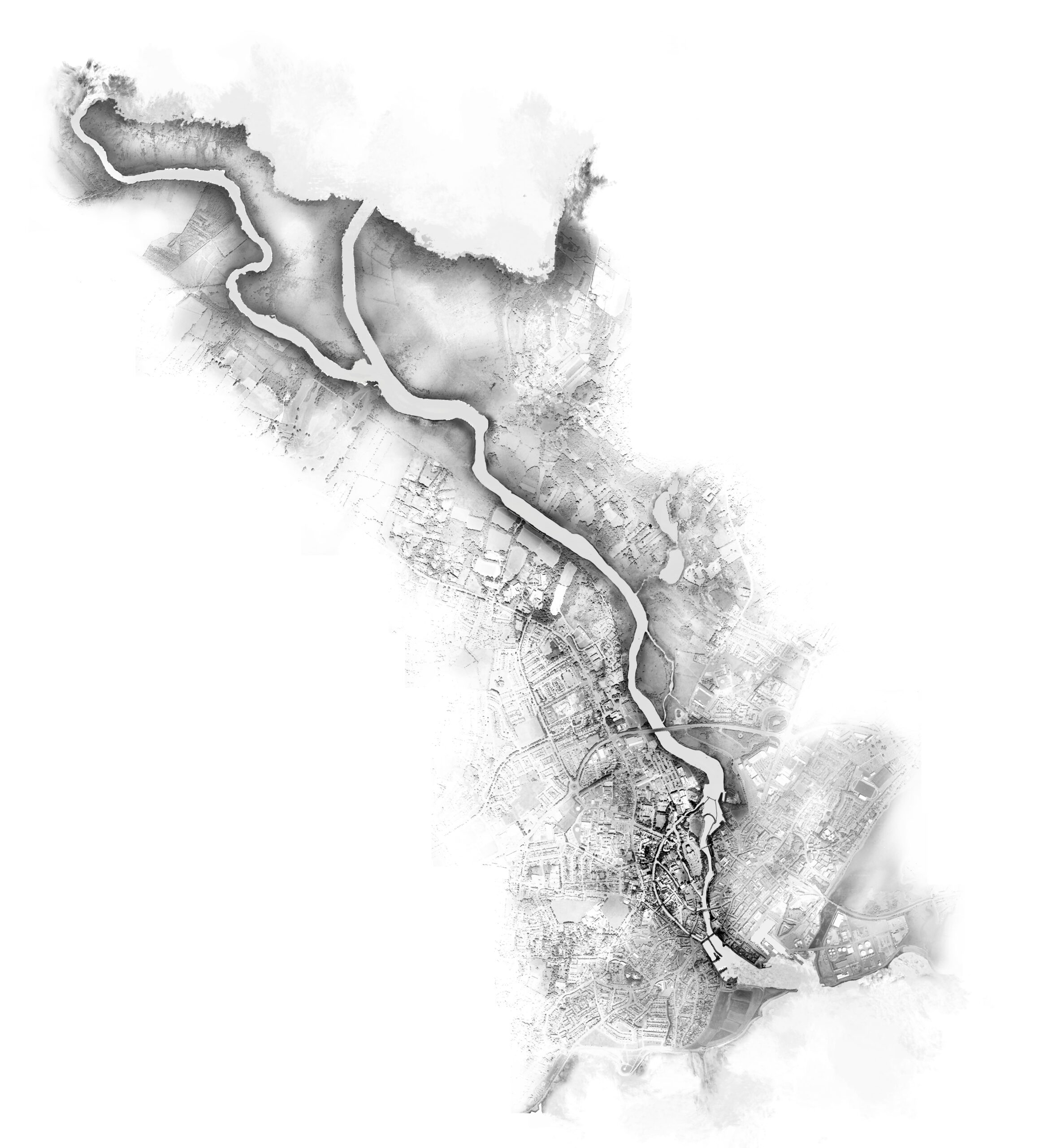
Laindéar Dhroichead Átha – Drogheda’s Lantern

Restoring Drogheda’s Urban Design – Reclaiming the Identity of the Mall. This thesis is set in the medieval town of Drogheda, a place rich in history and cultural significance. It investigates the town’s past and examines the urban characteristics it once possessed, with a particular focus on public spaces designed for community use. The research traces Drogheda’s development over time. It highlights how the urban fabric has evolved, looking at how communal spaces have been neglected or forgotten.

The study looks at the shift in urban priorities following the introduction of the car in Ireland. Like many towns and cities, Drogheda adapted its infrastructure to accommodate vehicles which is often at the expense of pedestrians and public life. This research argues for a reimagining of Drogheda’s urban design through the reclamation of these overlooked spaces. It emphasises that the town historically embraced public generosity through its spatial design and explores how these values can be revived. The medieval quarters of Drogheda are rich with significant landmarks, and this project seeks to integrate these urban features into the design proposal. In doing so, it aims to reinforce a sense of local identity and create a civic space that invites the public to engage with and appreciate the town’s unique historical and architectural character.

A Palimpsest of Renewal

This thesis addresses the longed-for revitalisation of neglected Georgian heritage buildings through a mode of material sorting and reuse. The site sits at the lower end of the Georgian Newtown Pery Grid, founded by a cluster of dereliction within the city. Jesuit Lane becomes an organised, brick-vaulted matrix in which workshops that contribute toward a self-repairing city can take place. It integrates existing institutions such as the Sacred Heart Church and the Limerick Tutorial College, embedding itself within an already active civic fabric.

The programme unfolds within a realm of brick vaults extracted from the very city in which it stands. It includes educative and reparative workshops, a large church assembly hall, and material storage facilities, all emphasising the reuse of salvaged and redundant materials sourced from surrounding areas. Redundant materials become the central subject of the project, shifting from waste to resource. The site operates as both a hub and a form of spolia — a place where fragments of the city are gathered, catalogued, and reintroduced — enticing the city to repair itself through incremental, smaller-scale acts of intervention.

This thesis explores architecture as a provocation, or re-provocation, of our inner visionary selves. It questions current approaches to renewal within the built environment and challenges the tendency toward replacement over repair. This response lies in the mode of sensitive material sorting, with particular attention given to materials already embedded within the existing fabric. By recognising the latent value in what is already present, the project seeks to step toward a more sustainable architectural output. Ultimately, it aims to portray a world in which one empathises with the material before them — where architecture begins not with extraction, but with recognition, care, and reuse. The city becomes self-repairing.

Symbiotic Relationship of Humans & Rivers

The project explores the relationship between humankind and rivers: how humans perceive rivers and the two-way interactions that occur. It views rivers from a selection of perspectives such as the river as a life source, a transport route and a power source.

The site is the River Corrib and the surrounding land of Galway city. The design project will focus on Madeira Island, now a surface car park. The River Corrib once powered Galway city’s industry and trade but now has a much less prominent role in the city. The fact that the city is built on a massing of islands, shaped by a network of waterways, is no longer evident due to the orientation of public buildings and main routeways.

Education has long been an integral part of Galway city life. The city centre currently hosts a university, three secondary and primary schools. However, all three secondary schools are in the process of migrating outwards in search of larger grounds in the suburbs.

The aim of the project is to provoke public re-evaluation of the river and to re-orientate people towards it. The programme is a music school to strengthen the weakening educational framework of Galway’s city centre